
Amazon Is Quietly Using AI To Recap Kindle Books Without Authors Being Able To Opt Out

Image Source: SBS
Just as AI is becoming an increasingly controversial issue, Amazon Kindle has decided to launch Kindle Recap. The new feature will catch readers up on what happened in previous books in the series. Kindle Recap sounds cute, but Amazon will be scraping the entire work and using Generative AI for that summary of plot points.
A summary of plot points…just like a synopsis…wait, don’t they already exist?
Amazon also owns Goodreads, a website where readers can access the synopses (and reviews) for pretty much every book ever published. If Amazon had wanted to, it could have made this feature without touching AI.
But why is this causing so much upset? Surely new features can only benefit readers? Is it only Luddites spreading fear of technology, or is there a real reason to be concerned?
Books Are Valuable Data
It’s common knowledge that developers have been trying to get hold of large amounts of fiction for free. Meta scraped the entire Library Genesis (LibGen) data set (over 7.5 million pirated titles). In the resulting lawsuit, the court documents quoted senior managers at the social media company as saying it was “really important for [Meta] to get books ASAP.”
This is not the only incident. There have been numerous attempts from various engines (ChatGPT, Huggingface, etc) to scrape the fanfiction website AO3, from as recently as April 2025 and going back to 2022.
RELATED:

Image Source: Dev
Amazon Kindle hasn’t specified what it will be doing with the data taken from Kindle Recaps. Amazon has also been vague about the technical specs of the AI they will be using for Kindle Recap, and if it’s the same as the one used in their other products.
Their generative AI engine is used in a number of services, including their AI assistant (Amazon Q/ Nova), Bedrock, and Sagemaker. These all generate a great deal of revenue for the company, which would be boosted if their language capabilities improved overnight. Will Kindle Recap have any kind of isolation from the rest of Amazon’s network, or will it be feeding it?
Working For Free
To date, no fiction author has ever been financially compensated for the use of their work in AI training. Kindle Recap potentially could have pieces of their work turn up in AI users’ creations, even if it’s just a character suggestion or a paragraph edit. And Amazon supplies AI for businesses as well as individuals, so it’s possible that a large corporation could end up using an indie author's text/idea for a blog post or ad campaign script. For free.
Harper Collins did negotiate the use of some non-fiction titles, and the UK is currently working on a licencing law that would work similarly to how entertainment venues seek permission to play music. But nothing so far in the US.
There is no option for authors to opt out of Kindle Recap. Kindle has an estimated 80% share of the e-reader market. It is also the top revenue source for Indie authors, who have the most to lose.
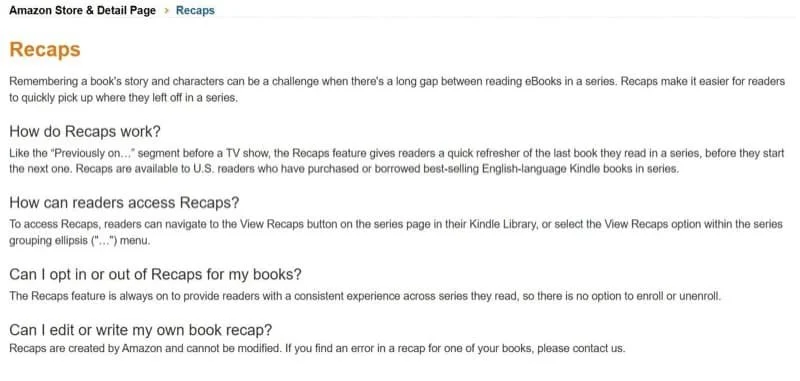
Image Source: Amazon KDP
AI Is Harmful To The Industry
Authors have already lost sales and become victims of scams due to AI. Jane Friedman had multiple fake AI books written under her name. They were listed on Amazon and subsequently posted to her Goodreads profile, even though she had nothing to do with them. Journalist Kara Swisher had fake AI versions of her autobiography, which were released at the same time as she was trying to sell her own.
Currently, most people can spot the difference between literature authored by a human and AI, but if Kindle Recaps ends up being used as a training tool, this scam could make it a lot harder.
And AI has caused physical harm. A family in the United Kingdom was poisoned after unknowingly buying an AI book about mushroom foraging. It even had a foreword from the ‘author’, but the information inside was not accurate.
Publishers And Authors Won’t Like Kindle Recaps
Kindle Recaps could have big ramifications for the industry in ways that Amazon might not have considered. Penguin Random House, one of the ‘big five’ publishers, specifically added the verbiage, “no part of this book may be used or reproduced in any manner for the purpose of training artificial intelligence technologies or systems,” to all of their new titles back in October 2024. Many agent/publishing contracts require new authors to declare they have not used generative AI, and there’s generally a large anti-AI sentiment on BookTok, which has already rallied together for the LibGen lawsuit.
Amazon might find itself in hot water if it can’t settle nerves and provide assurances. So far, companies that have forged ahead with a lack of transparency about AI have ended up in litigation. Although it is too late to put their genie back in the bottle, Amazon may end up damaging its relationship with readers, authors, and the publishing industry.
READ NEXT:

Source(s): The Guardian, The Verge [1], [2], The Independent, Jane Friedman, NPR, The Atlantic, PC Mag, Skyla Dawn Cameron, Amazon Kindle
Latest News


Featured





• All sizes are adult unisex
• Printed art on the front
• 100% cotton
• Pre-shrunk fabric
• Shoulder-to-shoulder taping
• Culture Slate Exclusive Design
See more products here