
'Star Wars' Guidebook: Geonosis
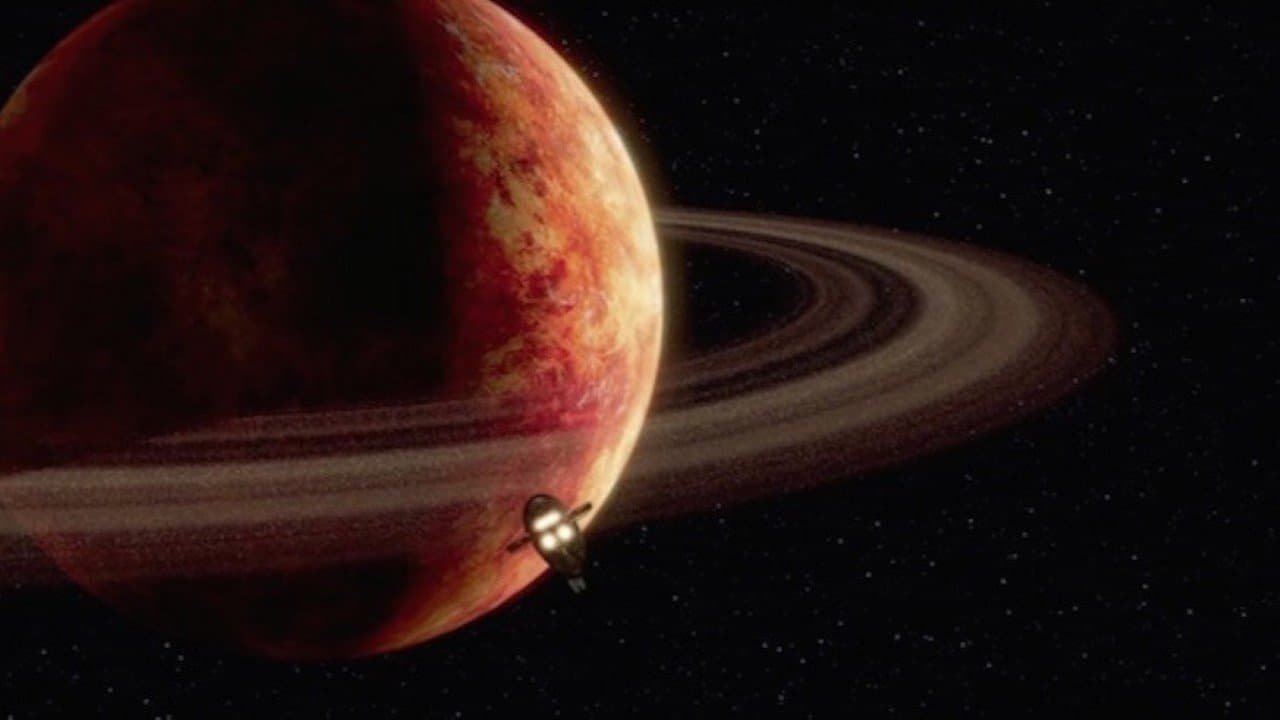
Image Source: StarWars.com
The Star Wars galaxy consists of billions of stars and millions of inhabited worlds. Some of them are birthplaces of certain characters, locations of temporary refuge, or sites of exchange of certain goods and services, but some of these worlds hold a greater importance for the overall story of Star Wars. One of these worlds is Geonosis.
General Information
Geonosis was found in a star system of the same name, and was orbited by several moons. It was located in the Arkanis Sector of the Outer Rim Territories but existed in something of a warm patch, located very close to other notable desert-climate worlds like Tatooine, Ryloth and Savareen.
RELATED:
Location
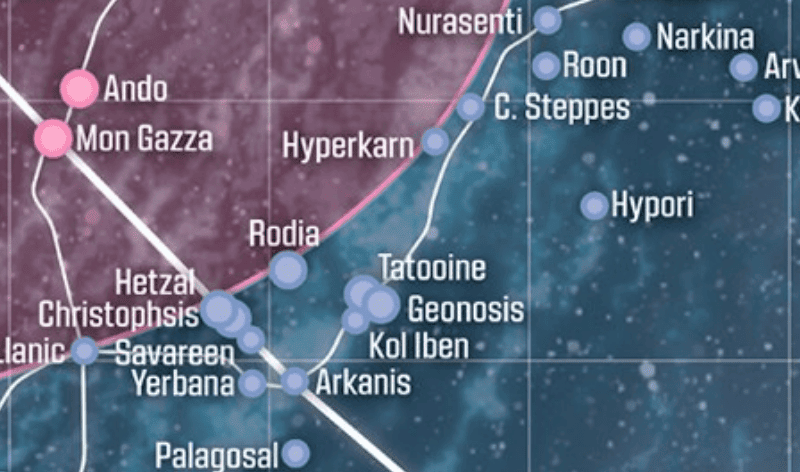
Image Source: StarWars.com
Landscape
As alluded to earlier, Geonosis was an arid world, covered in sand and great rock formations. Geonosis’ surface was frequently blasted by radiation storms, resulting in a lack of surface-level infrastructure. The hues of the planet skewed toward pale and dark shades of red and orange for the sand and rocks, but beiges and tan hues were also common. The world was covered in tunnels, the result of excavations by the native Geonosians to escape the radiation storms mentioned earlier and existed alongside natural caves and vertical shafts. Deep aquifers of groundwater sat below the planet’s surface, but could suddenly bubble up to the surface, creating flood conditions in surprisingly contrast to the planet’s wider terrain.
Population And Society
Geonosis appears to have been something of a monospecies planet, with the vast majority of the world’s population being made up of the native Geonosians. Semi-insectoid and known for their industrious mindset, the Geonosians had a stratified society made up of lower-class workers, winged warriors, and the winged, ennobled aristocracy. Their society was also divided between different hives, and was overseen by queens, though the exact nature of these queens is unclear when compared to Queen Karina the Great, seemingly the high monarch of the world given her noted status. Karina was at the very least, head of the Stalgasian Hive, the dominant force on Geonosis during the Skywalker Saga.
Major Settlements And Landmarks
Execution Arena
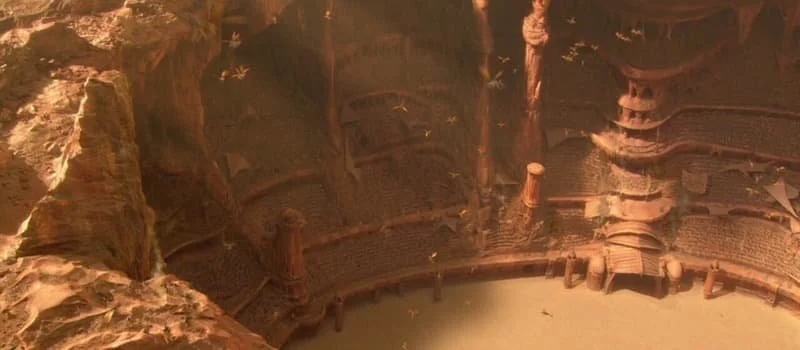
Image Source: StarWars.com
The Execution Arena was an ancient structure which once served as a place of trial for the legendary overlords who first ruled over Geonosis. Battling their rivals for the benefit of the public, the modern executions in the arena are largely for show and serve as demonstrations of Geonosian droid prowess as well as the skills of their own modern warriors. The arena was used as the attempted site of the deaths of Anakin Skywalker, Obi-Wan Kenobi and Padmé Amidala, with first a diverse array of animals sent against the prisoners, followed by hundreds of battledroids, Geonosian warriors, and heavier weaponry when other Jedi arrived to save the captured Jedi and Senator. The worker caste fled the conflict, and the Jedi were cut down from 200 to just a few dozen, but the prisoners were saved by the timely arrival of Jedi Grandmaster Yoda and a large contingent of clone troopers. The Arena was also the site of Jango Fett’s death, executed by Mace Windu after the two entered a duel. Unfortunately, the young Boba Fett was a witness to the beheading move made by Windu that killed the young man’s father.
The Progate Temple
Located far from known Geonosian settlements, the Progate Temple was a site of veneration, though who was being venerated is unclear. The monarch of the Stalgasian Hive, Karina the Great, retreated to the Temple even before the outbreak of the Clone Wars, and remained there when her planet was taken over by the Republic. Dwelling in the deep warren of catacomb passages, she enhanced her protection by using Brain Worms on Geonosian corpses, and later plotted with Archduke Poggle the Lesser to spread the Worms to Jedi in pursuit of the Geonosian noble. However, after Anakin Skywalker and Obi-Wan Kenobi arrived, Karina’s isolated hiding place became her apparent tomb, as she was buried under rubble as the catacombs collapsed onto her, many Brain Worms, her eggs, and the zombified Geonosians.
Notable Fauna
Geonosis had limited wildlife, with the only seen examples being the hardy Orray and the mysterious Brain Worms. The first was a vaguely crocodilian four-limbed animal, and served as a beast of burden to the Geonosians. By contrast, the Brain Worm was some kind of organism that had a symbiosis with the Geonosian Queen Karina the Great, perhaps all Geonosian queens, and could allow the reanimation of corpses through manipulation of the body. The Brain Worm could also influence living beings, enslaving them to a hive mind loyal to the Geonosians, though they were extremely susceptible to cold temperatures. One major threat on Geonosis which remained unseen in canon were huge insectoid creatures called Mereths, which dominated the world’s food chain.
History
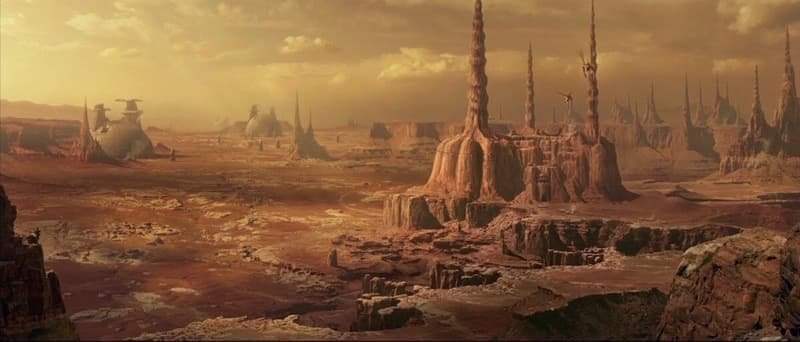
Image Source: StarWars.com
Geonosis came to galactic prominence during the end of the Galactic Republic, and the rise of the Galactic Empire. It became the site for considerable investment by several major corporations with strong ties to the Separatists, even as these groups also maintained links to the Galactic Republic. This investment appears to have largely happened in secret, or at least the Republic was unaware of the scale of investment, as vast droid foundries were constructed and the beginnings of a droid armor were manufactured on the world. B1 battle droids, already designed and manufactured by the Geonosians for the likes of the Trade Federation, escalated in production, and by the cusp of the Clone Wars, huge facilities churned out droids for the secret army being assembled by Count Dooku. At the same time, Geonosian weapon designers were finishing the earliest designs for the Death Star.
The Jedi soon discovered the significant military build-up, and came to the rescue of the captured Obi-Wan Kenobi, Anakin Skywalker and Padmé Amidala as the Geonosians and Separatists sought to execute them in the aptly-named Execution Arena. While the Geonosian spectators fled, the Jedi were cut down by warriors and hordes of battle droids, though the upper-hand for the Separatists was lost when the Clone Army appeared in force to support the Jedi deployments. The First Battle of Geonosis was ultimately a Republic victory, though many Separatist assets and leaders successfully evacuated off-planet, rendering the victory somewhat hollow.
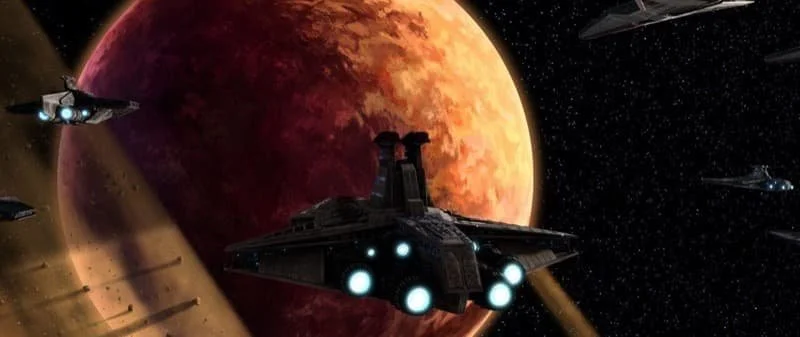
Image Source: StarWars.com
The Republic’s control over Geonosis did not last for too long, as the planet secretly fell from their control, with further investments by corporations fueling efforts to rebuild the world’s droid manufacturing capabilities. Likely aiding in this build-up were the presence of Brain Worms linked to the Geonosian queen Karina the Great, which likely infected and controlled key Republic officials. The Republic eventually learned of the planet’s fall back to the enemy, and a new invasion was launched, which aimed to capture Archduke Poggle the Lesser alongside the dismantling of the world’s industrial capacity yet again. This second invasion also uncovered Queen Karina the Great and her Brain Worms, putting an end to both threats, though the Brain Worms almost became a serious issue via escape from the planet.
Yet almost as soon as Poggle had been locked up, and the droid foundries had been torn down, a new industrial project began on Geonosis. High-up echelons of the Galactic Republic had been brought on to a project to build a superweapon, using “stolen Separatist plans” as the base for a tool to bring the war to an end. Having originally designed the weapon, the Geonosians proved the first people turned to in order to build it, and so they began. Facilities in orbit of their world started the construction, and Poggle the Lesser received greater freedoms in exchange for his cooperation. Keep in mind, this was all before the emergence of the Galactic Empire, but this project was one of the key steps on that path. When the Empire did emerge, the project over Geonosis continued, and then, the Empire turned on the weapon’s original workforce.
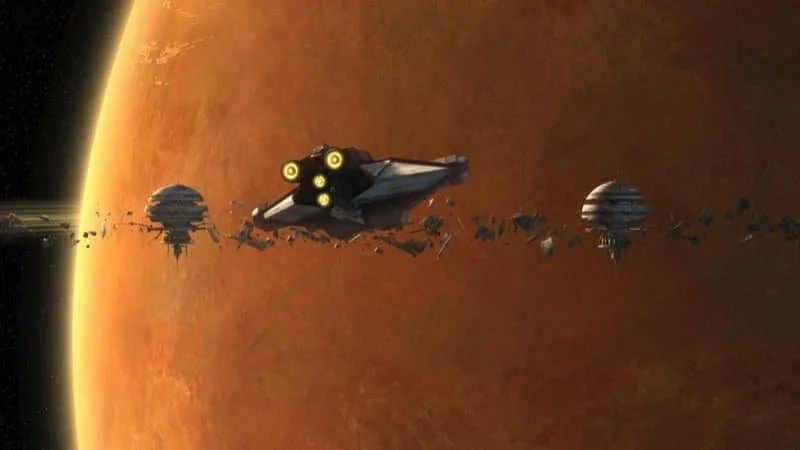
Image Source: StarWars.com
After a certain point in construction, when the colossal space station was capable of being moved or after its departure, the Empire attacked the Geonosian people. Making extensive use of chemicals to sterilize the world, they purged 100 billion beings to ensure the Death Star remained a secret. There were some survivors, but the Geonosians still went practically extinct, while the planet had a tight cordon drawn around it to ensure no one could visit, and if they did, they couldn’t get out alive. Word of some Imperial project related to Geonosis eventually leaked to the early Rebellion, who sent several missions to the world. The Empire quickly cleaned up what remained of the Death Star’s construction facilities in orbit after the first of these incursions, though not all evidence of their crimes was able to be wiped from the surface of the world. The slaughter of the Geonosians and the desolation of their planet, became one of the many injustices the Rebel Alliance fought to reveal and prevent in the future.
The world was briefly visited by Darth Vader and Doctor Aphra on a quest to recover droid manufacturing facilities after the Battle of Yavin, only to discover the heinous results of the Empire’s old chemical attack. A queen, perhaps the last surviving queen, had been rendered sterile and likely somewhat insane. Connecting herself to a machine to produce droids as her “children,” the device was taken by Vader and his allies for his own uses. We don’t see or hear much of Geonosis past this point, suggesting a bleak future for the planet and its people.
Appearances of Geonosis in Canon
First appearing in Episode II: Attack of the Clones, Geonosis has seen small bits of development in canon, helping establish it as the first site of the Death Star’s construction in Catalyst: A Rogue One Novel and Rebels Seasons 2 and 3. Its bleak future, though, has been somewhat disputed by behind-the-scenes figures like Pablo Hidalgo, who suggest that for as dead as the planet might seem, the world is full of deeper passages, meaning the Geonosians might have survived the desolation of their homeworld. Despite these suggestions, canon storytelling has yet to make any direct reference to such survival scenarios, and it seems likely that Geonosis will remain a clear testament to the Empire’s extreme cruelty.
CultureSlate: Made by humans, for humans
READ NEXT:

Latest News


Featured


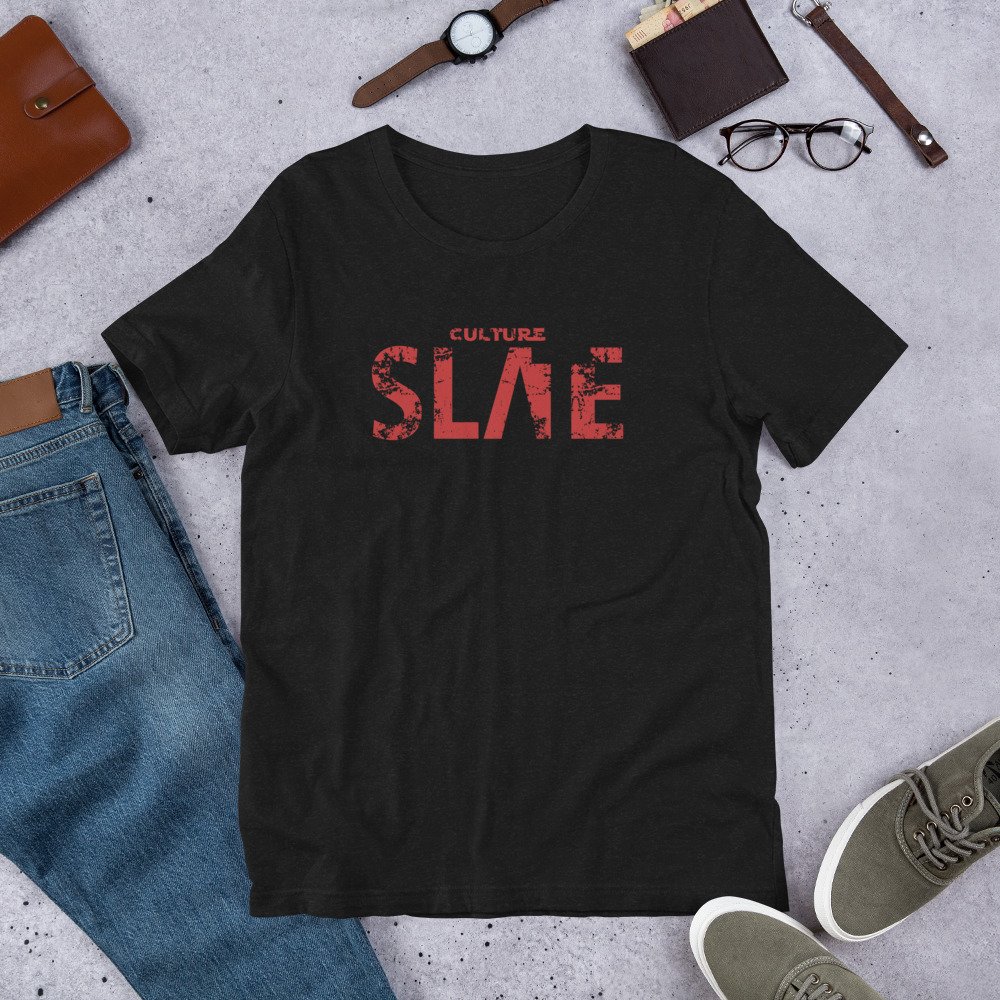


• All sizes are adult unisex
• Printed art on the front
• 100% cotton
• Pre-shrunk fabric
• Shoulder-to-shoulder taping
• Culture Slate Exclusive Design
See more products here