
Satellaview: Nintendo's Unique Satellite Gaming Peripheral

Image Source: CultureSlate
The Super Nintendo Entertainment System (known in Japan as the Super Famicom) was a successful console by Nintendo, with several hit games under its belt. With the emergence of the Nintendo 64, there was a dedicated effort to expand the lifespan of the system. This birthed the add-on known as the Satellaview, which had a unique concept: games broadcast to the system via satellite. Though interesting for a gaming system, today’s gamers are likely to be turned off by such a process. Where did this system come from, and why was it only available in Japan? The story of the Satellaview is an interesting tale, one which introduces an unfamiliar face.
Enter Satellite Digital Audio Broadcast Co., Ltd., trading as St.GIGA. A satellite radio company based in Tokyo, St.GIGA was a subsidiary of satellite TV station WOWOW, which focused on satellite radio. Using a unique “tide” based time table, they became known for their ambient music broadcasts and the "Tides of Sound", where songs from one genre would “flow” into the next. Initially successful, by 1994, Japan’s economic stagnation meant financial difficulties for St.GIGA. This is where Nintendo comes in, purchasing a 19.5% stake to help the company and restructure it. Nintendo’s expertise in video games would be the genesis of the Satellaview.
RELATED:

Image Source: Wikipedia
Their plan would coalesce into the Satellaview. ST.GIGA would handle the satellite and broadcasting services, while Nintendo and other third parties would work on the software. The Satellview would make use of satellites for music, magazines, and ST. GIGA’s trademarked Tides of Sound. Of course, what the peripheral would become known for was its games, distributed via satellite services; we’ll have more details about that later. The Satellaview was allegedly developed alongside the Nintendo 64 and the Virtual Boy, and it would ultimately launch on April 23, 1995.
The Satellaview was attached to the bottom of the Super Famicom and came with a special cartridge with a port on top. The cartridge contained BS-X: Sore wa Namae o Nusumareta Machi no Monogatari (Broadcast Satellite X: Story of the Town Whose Name Was Stolen), a hub for the system that served as a game in its own right, essentially a mix between Twin Peaks and Earthbound. There, players could access downloaded games and other services, which could be saved using a memory card on the top port. You had to be there at certain times to tune in to the broadcasts.
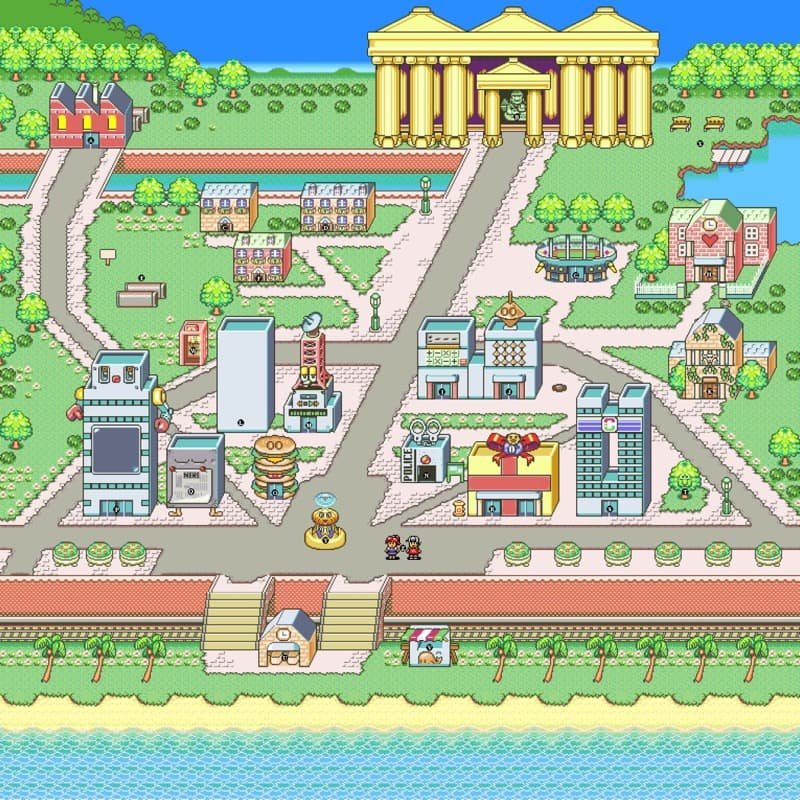
Image Source: Time Extension
The Satellaview’s games tended to take advantage of the system’s satellite services in order to show off its full capabilities. One famous example of this was the Soundlink games, featuring live voice acting by professional actors and radio personalities; these could only be played for a limited time on a live schedule because of this. Nintendo also held various tournaments for some of its games, which allowed players to compete for various prizes. Third parties who published games for the peripheral included Squaresoft, Taito, Konami, Capcom, and Seta.
Despite initial success for ST.GIGA, Nintendo ultimately recognized the peripheral as a bomb for them. What happened? Though it had a decently large player base, the peripheral was expensive, and many didn’t have an easy time getting it, as it was only available through mail order. In addition, ST.GIGA continued to have financial troubles, which would drag down the success of the system. In spite of this, the Satellaview did have a dedicated fanbase, who continued to download the games and talk about them with others. It wasn’t long before the Satellaview would be winding down, but many were there to keep it going.
With ST.GIGA continuing to have financial troubles, Nintendo would cut ties with the company, removing support for the Sateleview. Despite this, ST. GIGA would support the add-on itself until 2000, when it merged with WireBee to form Club Cosmo. Since then, hobbyists have been keeping the Satellview alive, preserving games and discussing the peripheral. For more details about this forgotten part of Nintendo’s history, we recommend Did You Know Gaming’s video on the topic, which will be linked below. Until then, we will see you guys at the local arcade, online, or anywhere there might be a new gaming scoop.
READ NEXT:
Source: DidYouKnowGaming

Latest News

Featured




• All sizes are adult unisex
• Printed art on the front
• 100% cotton
• Pre-shrunk fabric
• Shoulder-to-shoulder taping
• Culture Slate Exclusive Design
See more products here