
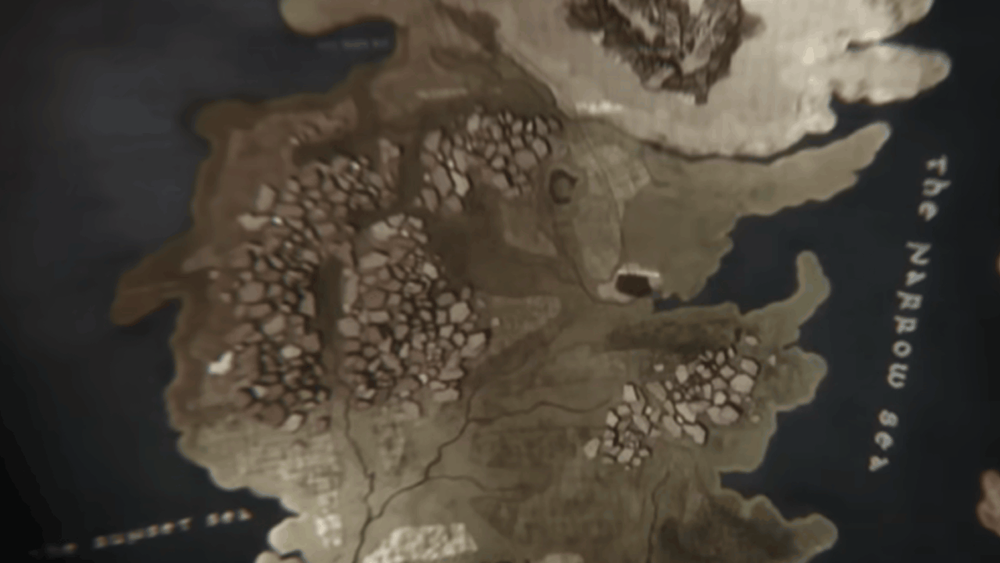
Image Source: YouTube
The A Song of Ice and Fire franchise is home to a massive fictional world (literally, distances and scale in that universe are simply gigantic), home to three major continents, countless small islands, and strange populations dotted in their settlements or living spaces.
On the continent of Westeros are the Seven Kingdoms, seven regions distinctive from each other and once rivals for power, alongside another territory exclusively the property of the land’s royalty. The conquests of King Aegon I made the rulers of these Kingdoms bend the knee to him, making them all lords and ladies over other nobles across the Seven Kingdoms.
RELATED:
With more stories set in Westeros on the horizon, and A Knight of the Seven Kingdoms likely set to visit each of these regions in the coming years, CultureSlate wanted to clue viewers in on some of the history found in each of these diverse regions.
The Crownlands
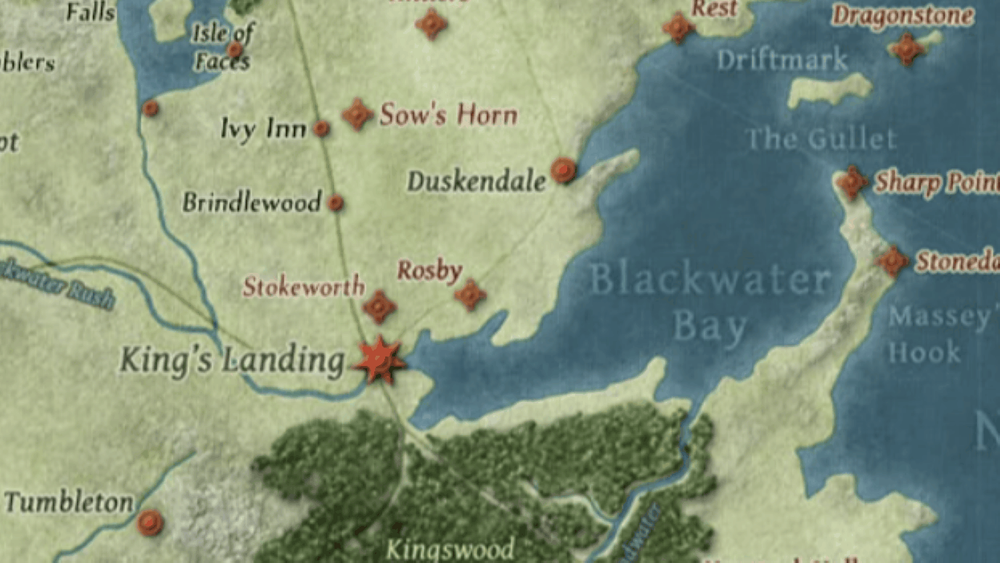
Image Source: awoiaf.westeros.org
The territory immediately surrounding the capital city of King’s Landing is known as the Crownlands. Owned and controlled by the royal leadership of the Seven Kingdoms, this was the region to host the original landing of Aegon Targaryen’s forces, and soon held the ramshackle Aegonfort as a fortress on the mainland for the Targaryen dynasty. Initially organically sprawling, Targaryen rulers starting with Aegon I made major changes, turning the Aegonfort into the Red Keep and transforming King’s Landing into a proper city with paved roads, and many other notable sites.
Aside from King’s Landing, the Crownlands are home to other nearby settlements and their leading families who subsumed themselves under the Targaryens as direct vassals, and is also home to an exclusive hunting ground kept for the personal use of Westeros’ monarchs.
The Stormlands
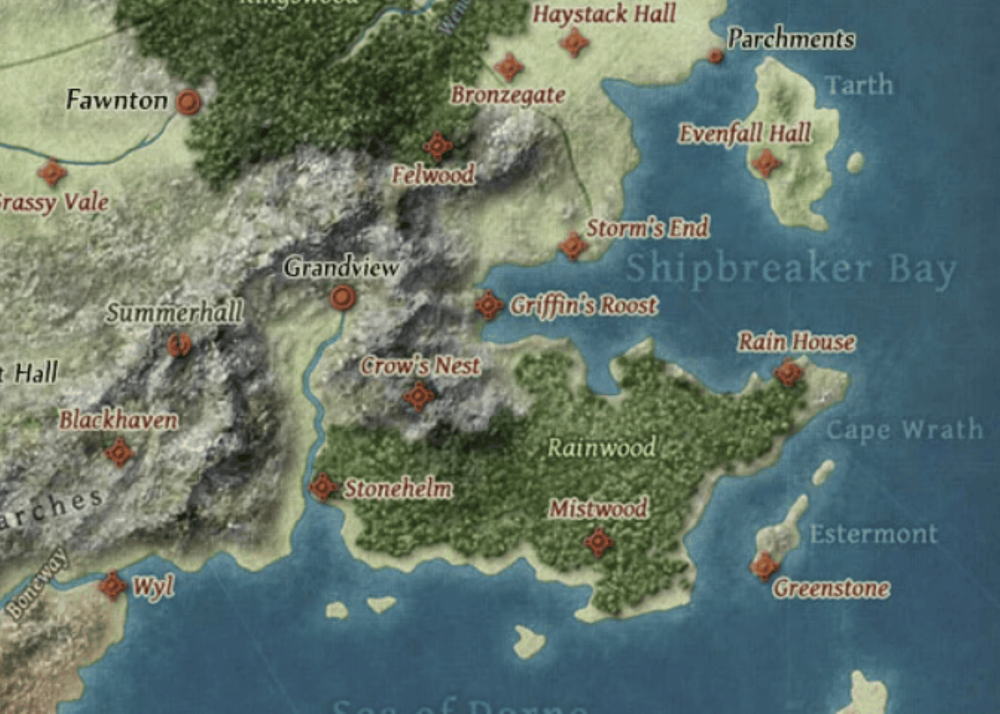
Image Source: awoiaf.westeros.org
A storm-racked region known for its rainforests and stubborn inhabitants, the Stormlands are one of the more geographically unique regions of Westeros. Its greenery is sharply contrasted with the arid terrain of its southern and south-western reaches, which border the sandy terrain of Dorne, whose people the Stormlanders have held an enmity with for centuries.
The Stormlands has a major industry in the production of timber but as it is also surrounded by the Sea of Dorne and Shipbreaker Bay, has thriving coastal trade centers. The region was ruled by House Durrandon for perhaps millennia, but after the final Durrandon king helped incite Aegon’s Conquest and died in battle, House Baratheon adopted their sigil and position leading the Stormlands. They rule from the ancient castle called Storm’s End, a massive structure that overlooks Shipbreaker Bay, and other notable Houses in the area include Connington, Selmy and Tarth.
Dorne
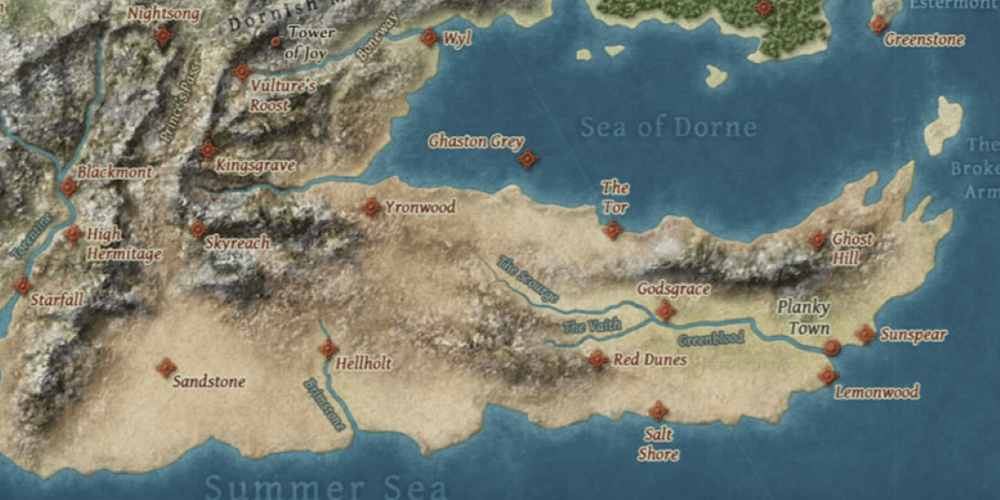
Image Source: awoiaf.westeros.org
A land of extremes with a unique cultural history, Dorne was a result of the fusion of existing humans living in Westeros, and the arrival of Rhoynish refugees from the annihilation inflicted on that culture by Old Valyria. The arid landscape, full of deserts and arid climates, still holds sources of water jealously guarded by noble families, while the few rivers in the region are also critical to trade and survival for many.
Dorne is an outlier in Westeros due to unique customs, and they refused to bend the knee to Aegon’s Conquest. Eventually brought into the realm through peaceful marriage between the Targaryens and the ruling House Martell, the region gradually became a reliable Targaryen ally. House Martell rules from the beautiful fortress of Sunspear, while another notable House in the region is House Dayne, renowned for their unique sword and the title of its bearer, Sword of the Morning.
The Reach
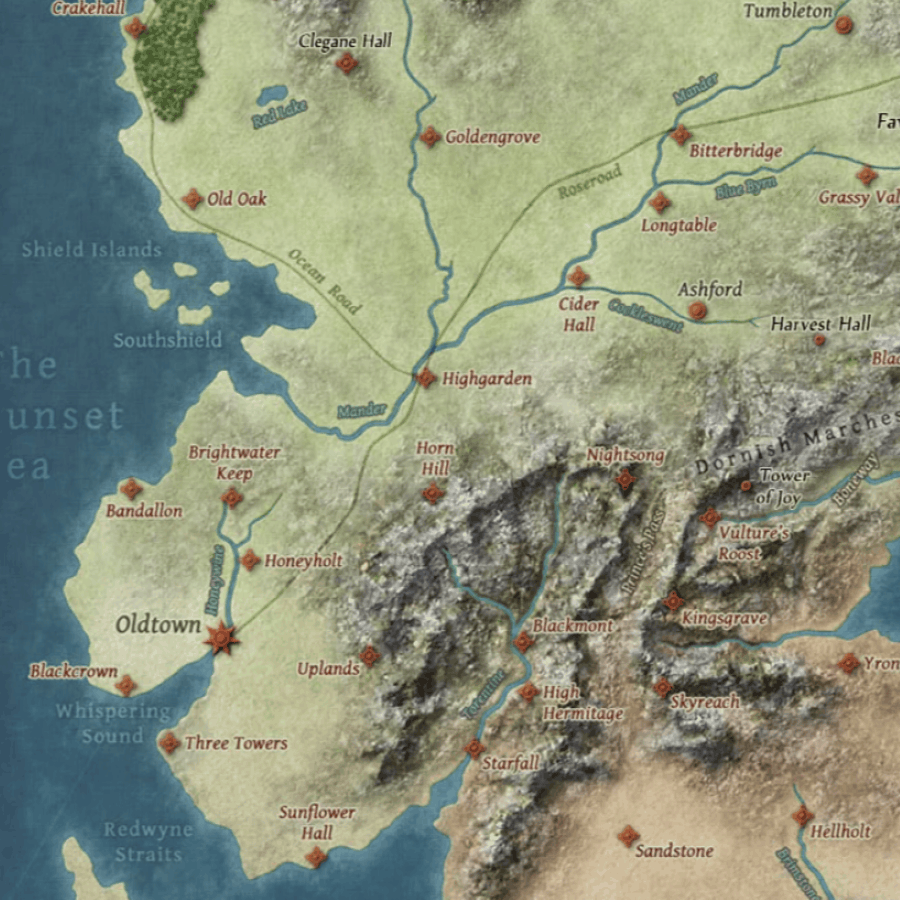
Image Source: awoiaf.westeros.org
The Reach is home to verdant terrain rivaling the green seen in the nearby Stormlands, though within the Reach, it is carefully cultivated, controlled, and used to bring about an immense surplus of food. Bordering the Sunset Sea, the region is able to explore these vast stores of grains, wine and more to other regions with ease, while the existing food surplus means it is the most populous of the Seven Kingdoms. Once ruled by House Gardener, their extinction at the Field of Fire in Aegon’s Conquest meant their stewards, the Tyrells, took up leadership of the Reach and now rule from the castle of Highgarden.
However, another major center in the Reach, nay, Westeros overall, is Oldtown, a powerful city home to a towering mysterious lighthouse, the religious heart of the Faith of the Seven via the Starry Sept, and the training ground for all of Westeros’ Maesters, the Citadel.
The Westerlands
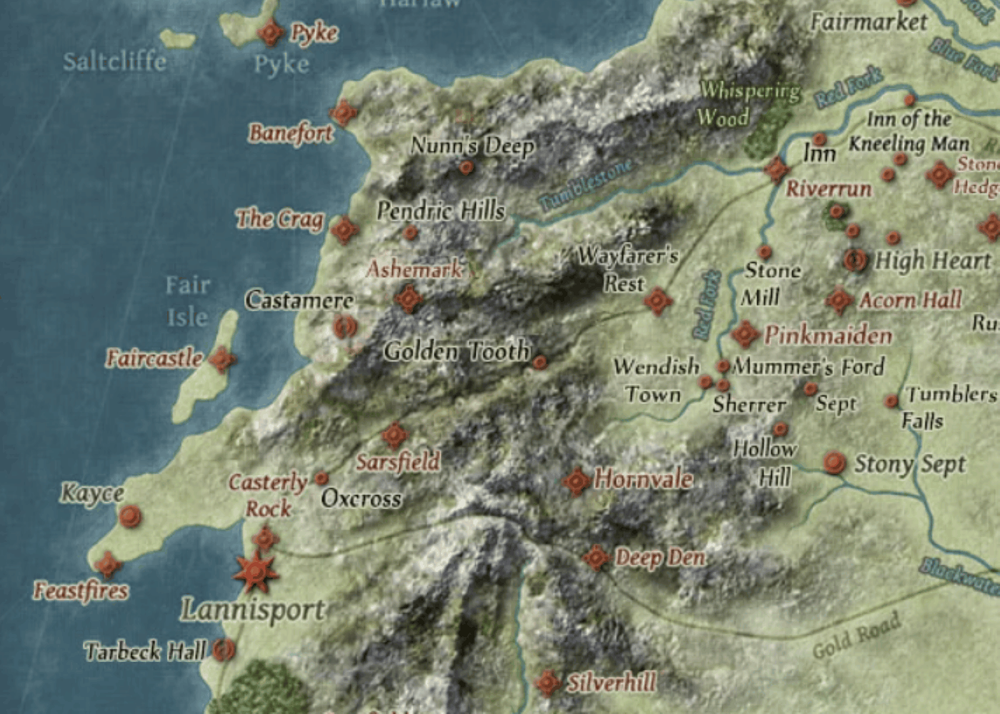
Image Source: awoiaf.westeros.org
The mineral wealth of the Westerlands is legendary across the world, even as far as Essos. A rugged region of rocky terrain that nonetheless has more fertile lands deeper into its interior, the Westerlands has had the displeasure of suffering at the hands of Ironborn raiders for centuries due to the nearby Iron Islands. The region was once ruled by the Casterlys of the Rock (hence the castle’s name) but myths tell of someone named Lann the Clever somehow tricking his way into inheriting or seizing the Rock, and helping end the old family bloodline.
The Lannisters, then, have been the rulers of the region for centuries, and while they suffered losses in Aegon’s Conquest, bent the knee to the dragon-riding king. The Lannisters still rule from Casterly Rock in the modern day, while other notable families of the area include the likes of Crakehall and Farman. Most notable, however, were House Reyne, whose lineage went extinct in a brutal act by Tywin Lannister after the other family challenged Lannister power.
The Riverlands
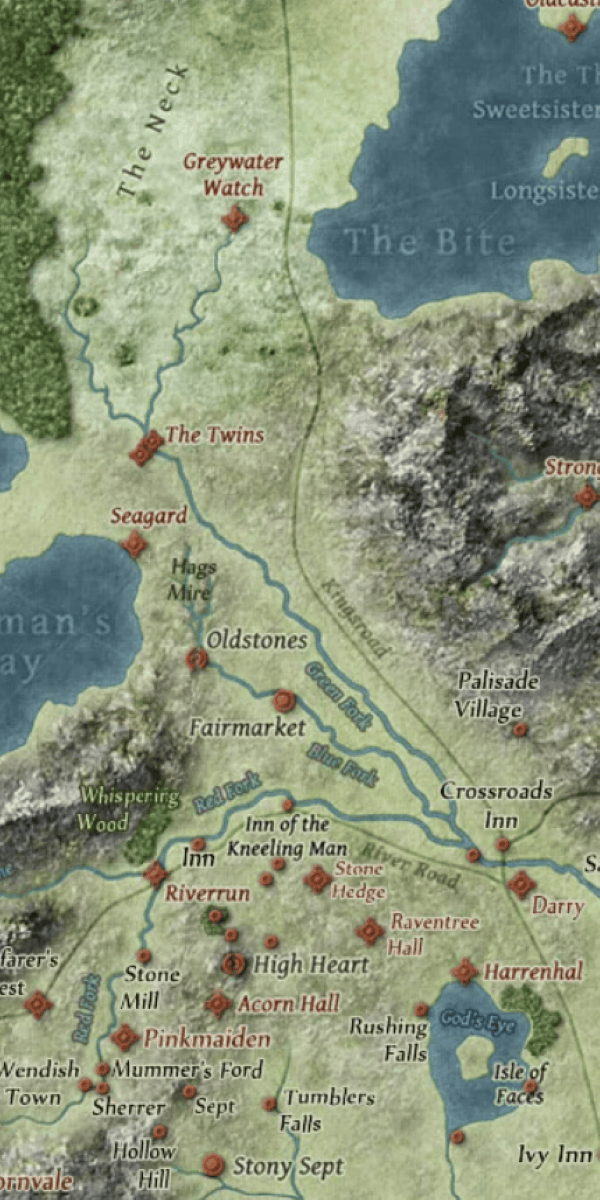
Image Source: awoiaf.westeros.org
The crossing point for most of Westeros, the Riverlands has had a tumultuous history. They were always the battleground where larger kingdoms fought, and saw their territory annexed by forces from their royal neighbors as part of these conflicts. The Ironborn, however, proved the greatest scourge, arriving in force to conquer and institute harsh rule over the local populace.
The grand and dreadful castle of Harrenhal, which had been built over decades of grueling, inhumane labor inflicted on the Riverlanders by the Iron Islanders, was burned when Aegon the Conqueror reached Westeros, bringing the Riverlanders freedom. The Tullys were then uplifted to rule over the region from their seat at Riverrun, which they have done ably ever since. Full of waterwaters, and small towns with markets and trading opportunities, the Riverlands is also home to notable Houses with the likes of the eternally feuding Blackwoods and Brackens, as well as House Frey.
The Vale
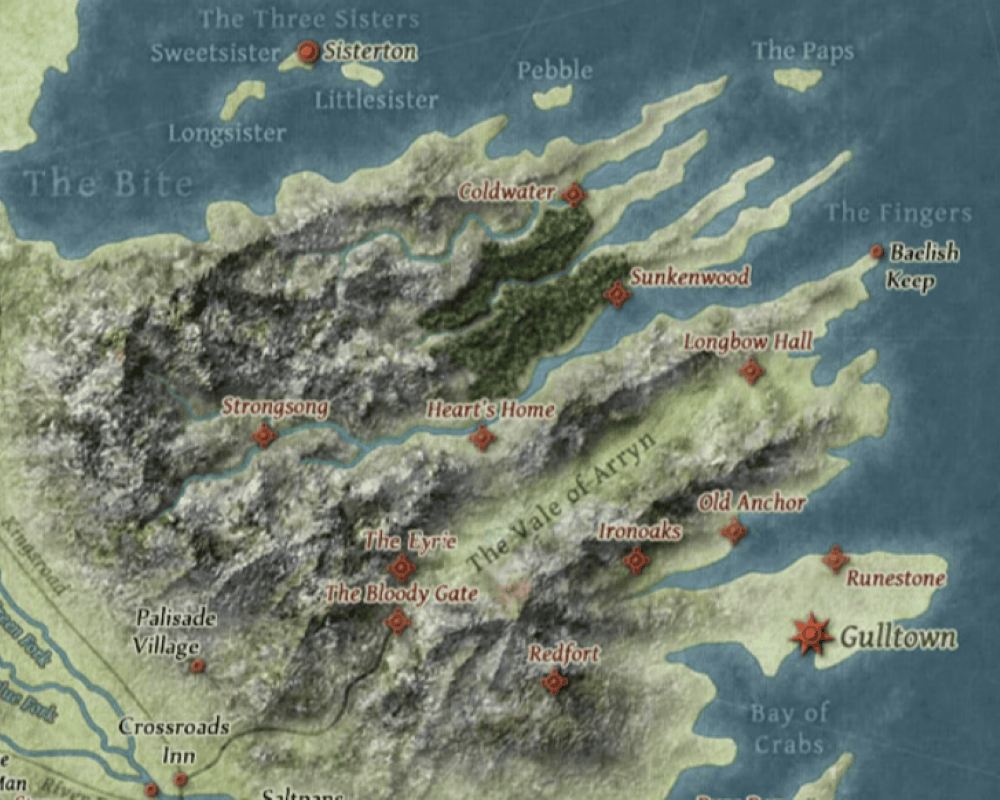
Image Source: awoiaf.westeros.org
The Vale is an insular region and home to a great many perils due to its harsh terrain. Surrounded by huge mountains populated by aggressive warrior clans who reject the social order of the rest of Westeros, a wide fertile mountain valley is nestled behind these towering natural walls, while sturdy coastal settlements provide opportunities for trade. The Andals first made landfall in the Vale when they invaded from Essos, and their blending with the First Men led to the culture seen in many places across Westeros. When Aegon the Conqueror came, however, his sister eventually rode her dragon past incredible defenses all the way up to the seat of House Arryn in the mountain-top castle called the Eyrie, where the Vale’s peaceful surrender was arranged between the mother of the young Arryn king, and Queen Visenya Targaryen. The Vale is, of course, a major exporter of stone, with quarries for many beautiful types of marble alongside the catches of its prosperous fishermen and the bounty of its fertile soil. Aside from the Arryns, other notable families in the area include Corbray, Baelish and Royce.
The North
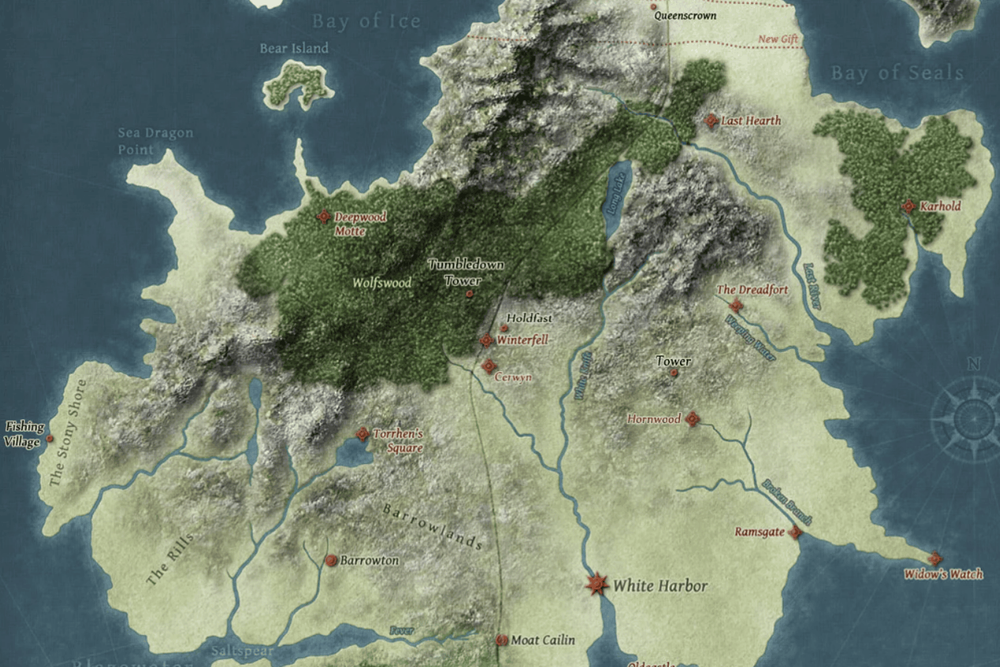
Image Source: awoiaf.westeros.org
The North is a vast region, thinly populated, and full of natural resources which see only limited exploitation. It is a region separate from wider Westeros because of its prominent adherence to the faith of the Old Gods compared to the Faith of the Seven which dominates the rest of Westeros. Northerners are uniquely adapted to the freak weather of Planetos which affects Westeros the harshest. Winter can last for years, even decades, on occasion, and so the North is home to a dour culture where sacrifice in the name of survival is considered essential, alongside the ever-present threat of death.
The North is also home to the Wall, an immense barrier which keeps the North divided from the permanently icy lands beyond, the populations of humans beyond its border being called Wildlings. The North has been ruled by House Stark for centuries from their castle of Winterfell, but their ruler bent the knee voluntarily to Aegon the Conqueror, allowing a 30,000-strong army to return in peace to their lands. The North’s other notable Houses include the cadet branch of the Starks called the Karstarks, and the likes of Manderly, Bolton, Reed and Mormont.
The Iron Islands
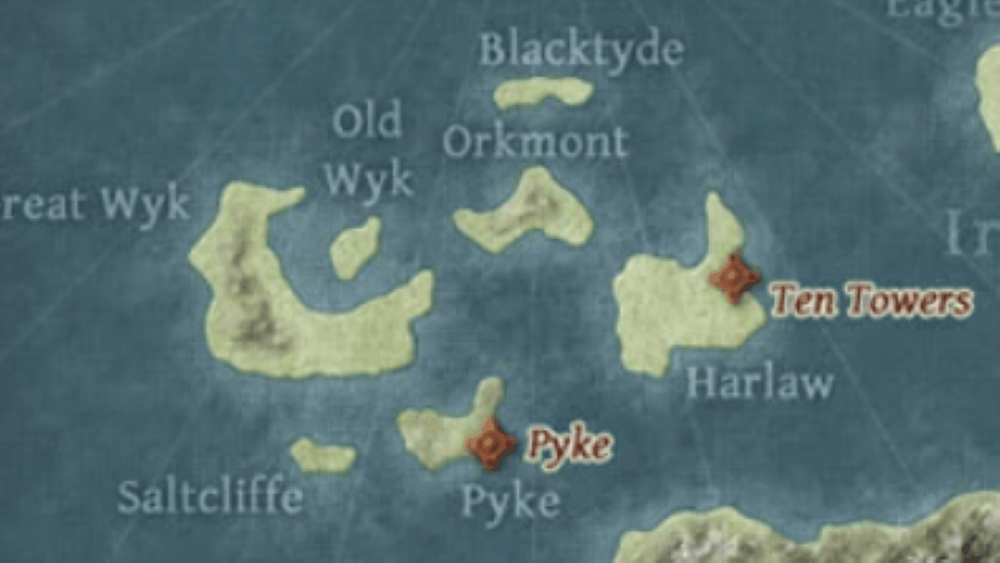
Image Source: awoiaf.westeros.org
Even more remote than the North in some ways, the Iron Isles are a series of islands off the northwestern coast of Westeros populated by a human culture distinct from both that of the First Men and the Andals who came after them. Instead, the Iron Islanders follow an aggressive way of life in worship of a duology made up of the Drowned God and the Storm God. The 31 Iron Islands are, as one might imagine, covered in iron deposits, but while some among the Ironborn are traders and merchants, the Islands experience a cyclical problem where external powers try to impose mainland social order on the population, leading to some acculturation of less violent ways, before an aggressive revival of the past often sees these past gains wiped out. As a result, the Ironborn have little to no positive relations with their neighbors.
They used to be ruled cyclically, by kings from a number of Houses, but the Targaryens forced this system to cease when they appointed House Greyjoy as rulers. Other regional Houses include Greyiron, Hoare and Drumm.
CultureSlate: Made by humans, for humans.
Please consider supporting our AI-free content via our Patreon page.
READ NEXT:
Latest News



Featured




• All sizes are adult unisex
• Printed art on the front
• 100% cotton
• Pre-shrunk fabric
• Shoulder-to-shoulder taping
• Culture Slate Exclusive Design
See more products here