
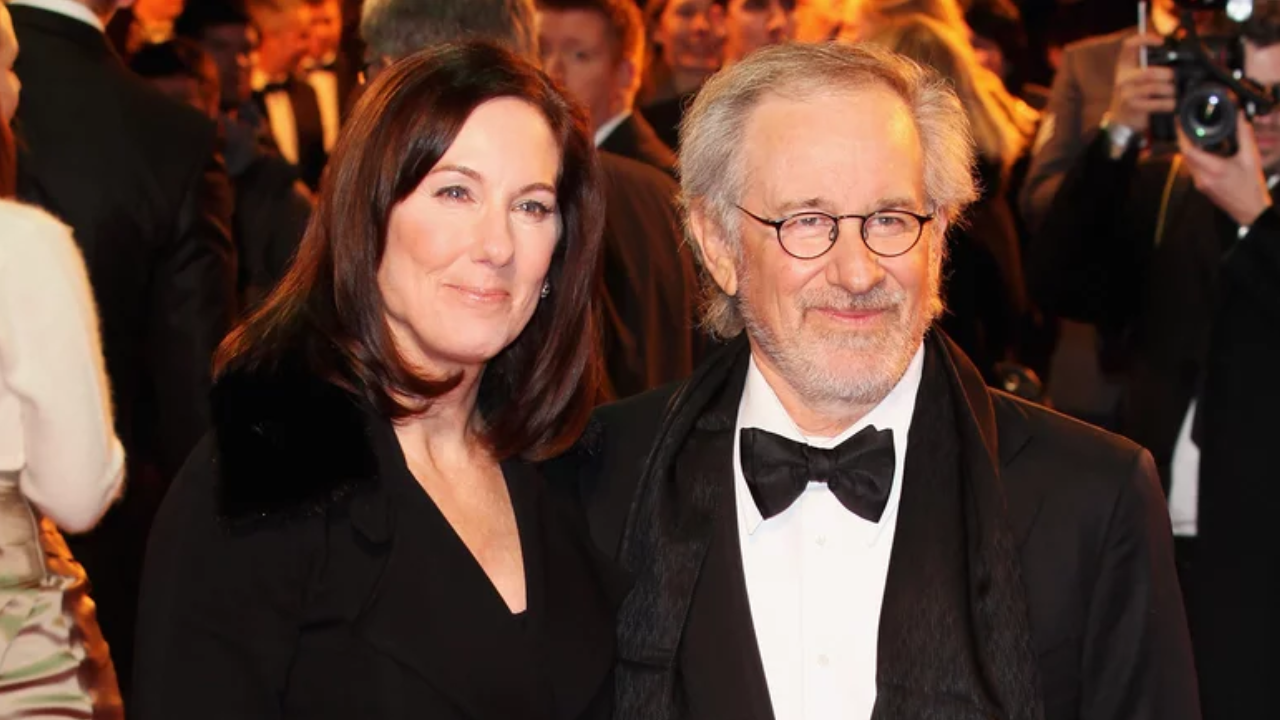
Kathleen Kennedy in a black dress and Steven Spielberg in a tuxedo with other people in the background
Image Source: Looper
In the past few years, when I have heard the name Kathleen Kennedy, I have thoughts of the contemporary Star Wars/Lucasfilm Disney franchise that she has, until earlier this year, helmed from 2012. For over a decade, Kennedy had been the person in charge of this phase of the Star Wars Universe, overseeing the new trilogy of Episodes VII, VIII and IX, live-action Disney + series, including The Mandalorian, and animated series, such as The Bad Batch. She was picked by George Lucas himself to steer the course of the Disney era Star Wars.
Now, she is going back to full-time movie producing, which is where she got her start many years ago with none other than Steven Spielberg. As I was watching The Goonies with my own children for the fortieth anniversary year, I saw both Kathleen Kennedy and Steven Spielberg’s names on the credits as producers. It made me wonder how many other collaborations they had done together, and I found out that they, together with Frank Marshall, had started Amblin Entertainment back in 1981. Here, I am going to take a look at the top seven collaborations these acclaimed movie makers have worked on together.
RELATED:
7: Lincoln(2012)
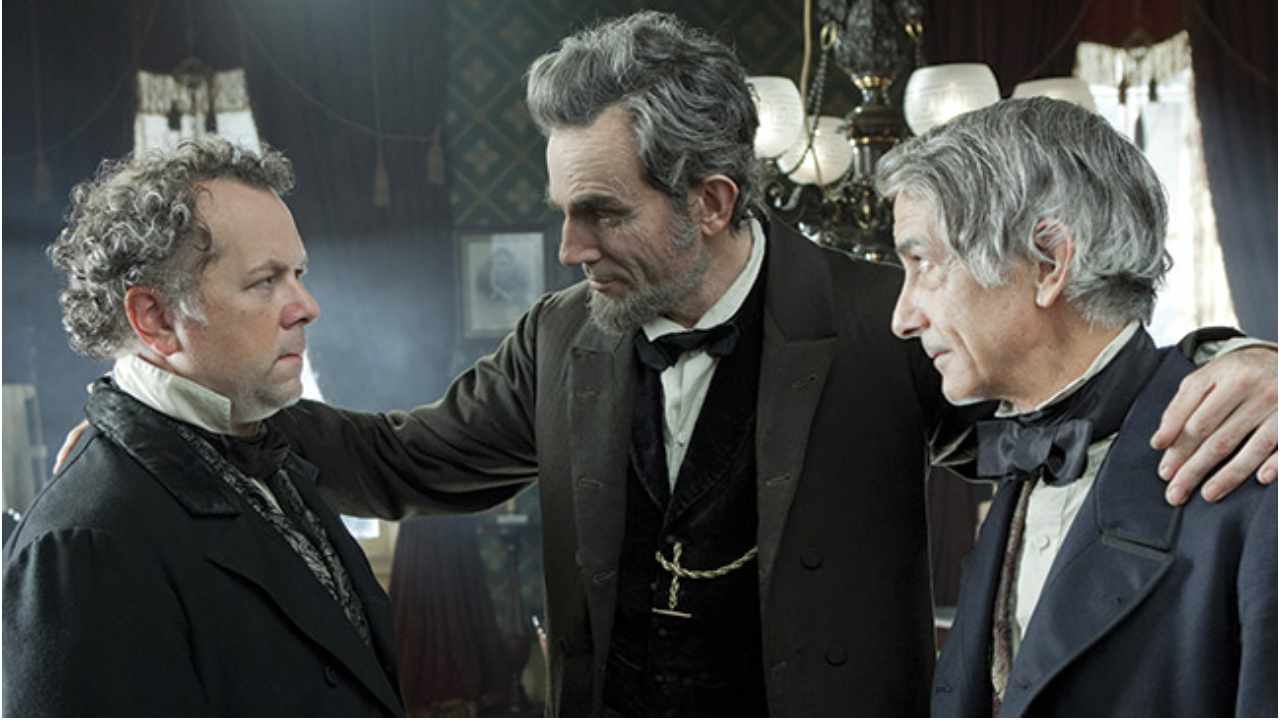
David Costabile, Daniel Day-Lewis and David Strathairn as their characters in Lincoln.
Image Source: The Hollywood Reporter
Not your average history lesson, Lincoln concentrated on the behind-the-scenes efforts to hold the United States together during the Civil War and the President’s efforts to pass the 13th Amendment. Daniel Day Lewis (Gangs of New York, There will be Blood, The Last of the Mohicans) won the Oscar for Best Actor for his portrayal of the American 16th President. Lincoln also garnered twelve Oscar nominations: Tommy Lee Jones and Sally Field for Best Supporting Actor and Actress, Spielberg for Best Director, Spielberg and Kennedy for Best Picture, Tony Kushner for Screenplay, and John Williams for Musical Score, amongst others.
While it is a long movie, it only centers on two months of Lincoln’s life, where he works to get the 13th Amendment to the United States Constitution passed. This amendment abolished slavery and all forms of involuntary servitude unless convicted of a crime. It ends with Lincoln’s assassination, but Day-Lewis shows us a very human president who truly believed in this cause.
6: Raiders of the Lost Ark (1981)
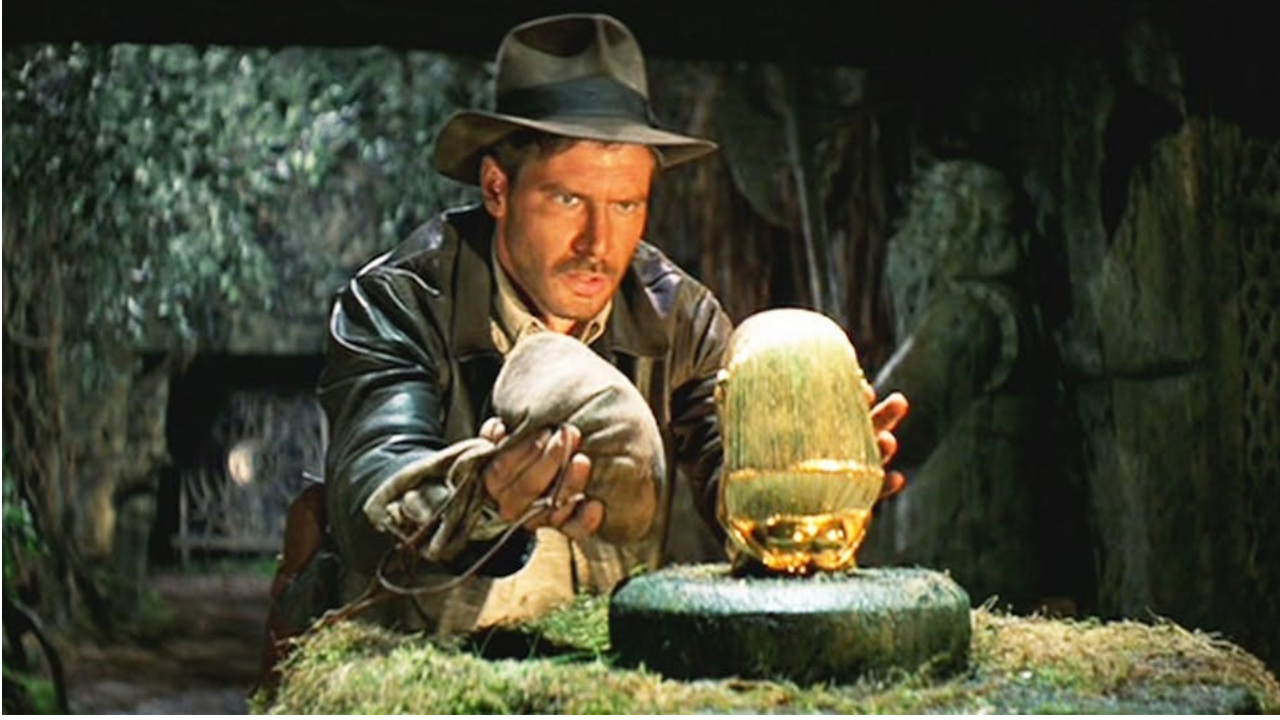
Harrison Ford as Indiana Jones uncovering a small golden statue on a round stone
Image Source: Andy Fowler Substack
Still early in her career, Kathleen Kennedy was an associate producer on this film, which helped her learn the ropes of managing a set and crew and the fundamentals of movie production; she was essentially director Steven Spielberg’s assistant. She also was one of the associate producers on the follow-up to this one, Indiana Jones and the Temple of Doom (1984). Raiders of the Lost Ark was the first time Kennedy and Spielberg worked on a movie together. She was working as Spielberg’s secretary and one day, Spielberg came to her and asked for Kennedy’s opinion on a script that was going to be his next movie. That was Raiders of the Lost Ark.
Thanks to her involvement in this feature, Kennedy got to travel for the movie shoot, and she met Frank Marshall, her future husband. (Kate Capshaw starred in The Temple of Doom and that is how she met her future husband Steven Spielberg!) Raiders of the Lost Ark centers on an adventurous archaeologist, Indiana Jones, who fights against the evil Nazis in Egypt to keep them from finding the lost Ark of the Covenant from Biblical times. Legend has it, whoever finds the Ark will render their army invincible, and we certainly can’t let the Nazis have it! Harrison Ford steps in as hero Indiana Jones, and the rest is movie history.
Raiders of the Lost Ark played in movie theaters for over a year; it was the highest grossing film of 1981, earning $354 million worldwide, and one of the highest-grossing films of all time. Along with the audiences that flocked to see it, critics also loved Raiders of the Lost Ark, calling it “an instant classic”, "breathless and incredible", and "exhilarating escapist entertainment". It won five Academy Awards and in 1999 the Library of Congress chose it to be preserved in the National Film Registry.
5: Jurassic Park (1993)
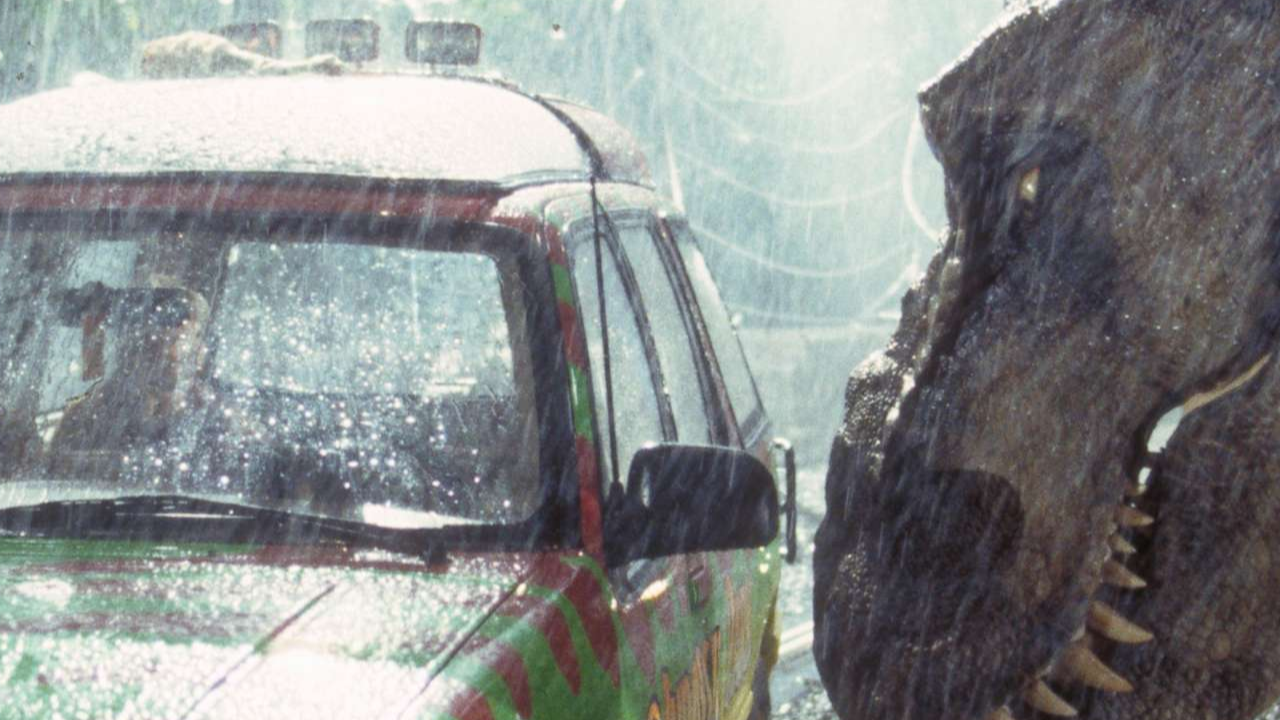
Dinosaur staring into a green and red car window in the rain
Image Source: ABC News
From the opening notes of John Williams’s epic score, Jurassic Park wowed audiences and truly brought to life the creatures from the prehistoric age. Based on a novel by bestseller Michael Crichton, it is simple enough - a rich magnate has his corporation figure out how to clone dinosaurs from DNA. The resulting specimens are placed in a safari-type environment that is aptly named “Jurassic Park”.
John Hammond is the entrepreneur who dreams up the idea, but he needs the endorsement of leading scientists to assuage his lawyers. He talks Drs. Grant and Sattler into checking out his theme park, along with his own grandchildren. Everyone is amazed by the dinosaurs, and there is philosophical chit chat as to whether or not this cloning should have ever happened. Theory is put into practice when the power goes out and the dinosaurs escape from their enclosures. Jurassic Park won three Oscars for Special Effects and Sound Effects and Editing. As Michael Crichton says,
“It’s just a delightful dinosaur story. At one point [Spielberg] said to me, ‘You know, when people go to this movie, they just want to have a good time and they want to believe the dinosaurs are real.’ And I thought, ‘That’s right. That’s the deal.”
And that is why this movie has expanded from a Park to an entire franchise World.
4: Back to the Future(1985)
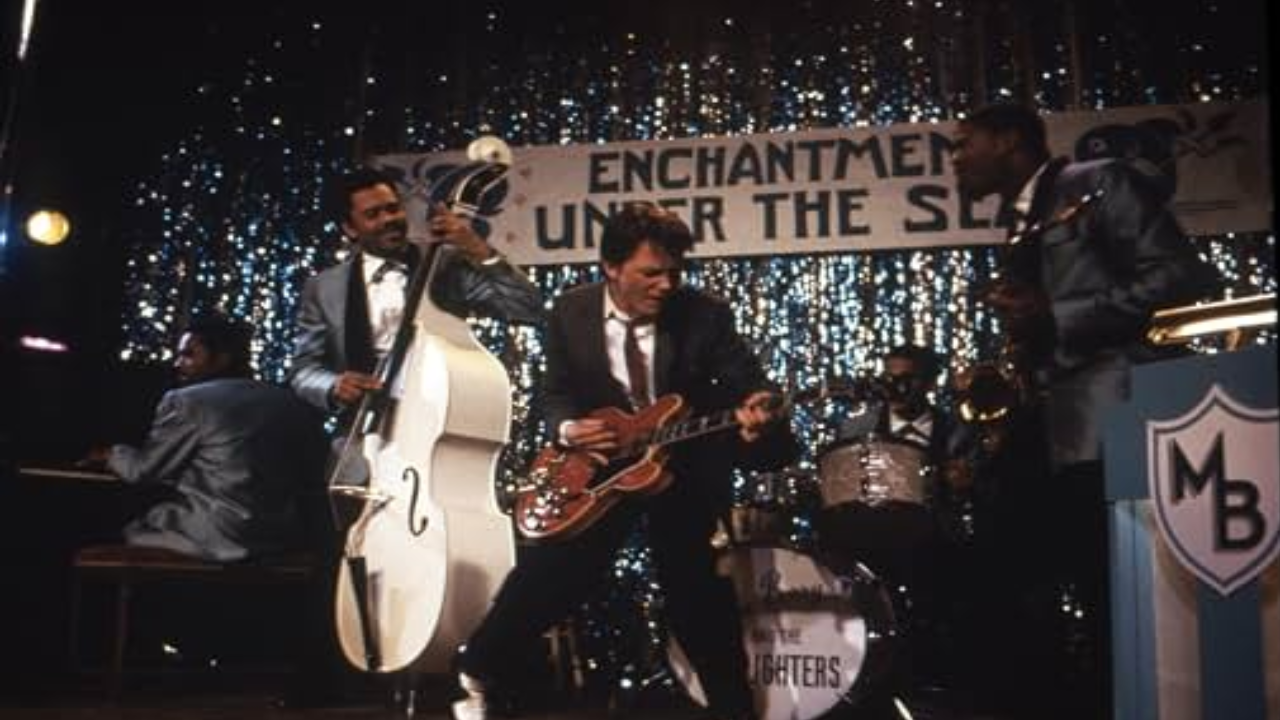
Michael J. Fox as Marty McFly on stage playing a guitar under a banner that reads “Enchantment Under The Sea” and next to a man playing a cello.
Image Source: IMDb
While the concept of time travel had been around for over one hundred years, Back to the Future, co-produced by Spielberg and Kennedy, took this idea to the next level. Since this movie hit the silver screen over forty years ago, there has been two sequels, a season-long cartoon that served as another sequel to the last movie, books, a musical production that can be seen in Tokyo, Europe, and on cruise ships, and various Comic Con outings - Lea Thompson is scheduled to be at the Con in Montreal in July, and my family and I have seen the DeLorean many times at the Motor City Comic Con. Even the President of the United States, Barack Obama, reached out on October 21, 2015 to Michael J. Fox, the actor who plays Marty McFly on Twitter (now X), saying:
“Happy Back to the Future Day, @RealMikeFox! Ever think about the fact that we live in the future we dreamed of then? That’s heavy, man,”
Michael J. Fox wrote back to the President:
"Mr President, I never dreamed I'd be talking about the future with someone who's making History."
What is the secret behind this franchise’s endearment? According to Anthony Digioia of Silver Screen Analysis, it is because it successfully combines “science fiction, teen comedy, romance, family drama, and adventure all at once”. There is something for everyone in this movie.
3: E.T.: The Extra-Terrestrial (1982)
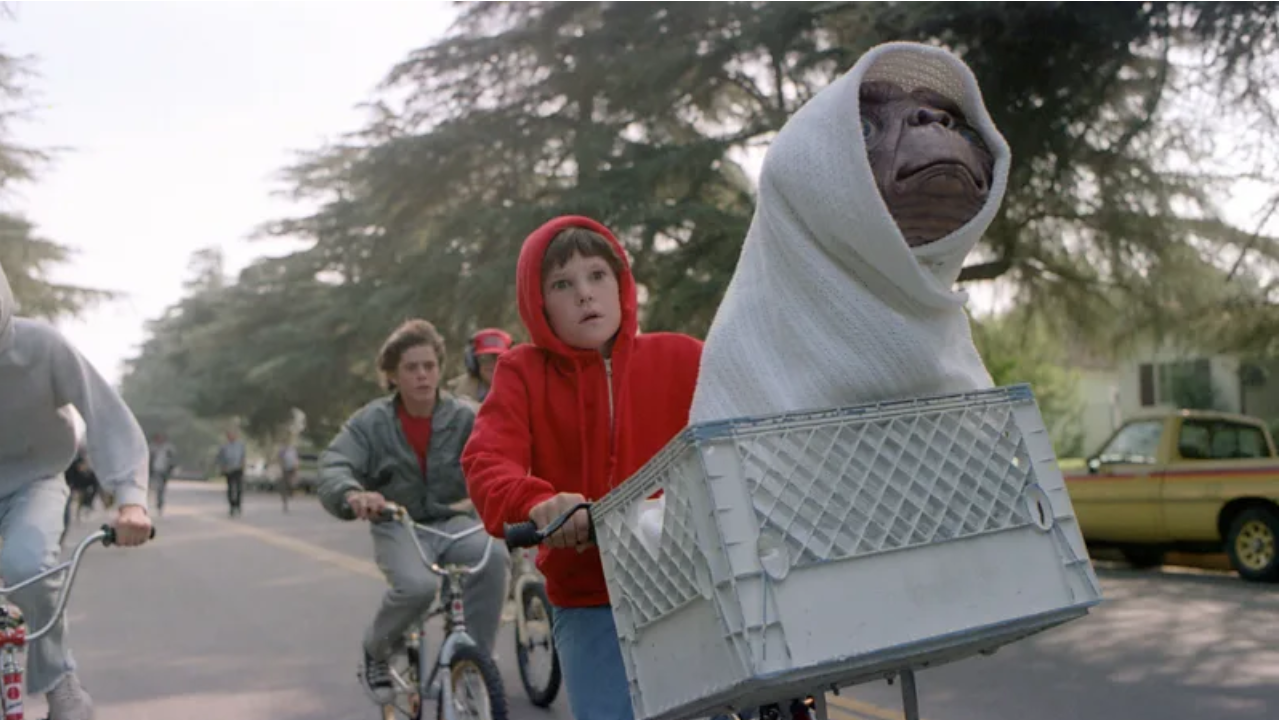
E.T. is wrapped in a blanket in Elliot’s bicycle basket while Elliot, in a red hoodie, is riding his bike in the street with two others.
Image Source: BBC
This film surpassed 1977’s Star Wars as the highest-grossing movie in the world when it was released in 1982. While E.T. takes place on Earth, it also has a science-fiction theme and involves aliens from other planetary systems. (And here, over 40 years later, Spielberg has continued with his fascination with aliens by recently releasing Disclosure Day.) Through this lens, Spielberg explored the universal themes of loneliness, friendship, and tolerance, which very much resonated with the audience.
E.T. tells the story of E.T., the Extra-Terrestrial, who is an alien botanist who is separated from his colleagues, who are forced to leave him behind. E.T. is found by Elliot and he takes E.T. home. Elliot shares E.T. with his brother and sister, and they decide to keep E.T. a secret from their single mother. This ends up being more complicated than they expected, and the government authorities catch up and put them all in quarantine. E.T. is able to help Elliot and his family and friends escape on their bicycles, leading up to one of the most iconic scenes in movie history. In a tearful good-bye, E.T. assures Elliot that he will always be in his heart. Cue the tears and reach for the Reese’s. In 1994, the Library of Congress put E.T. in the National Film Registry for being "culturally, historically, or aesthetically significant."
2: The Color Purple (1985)
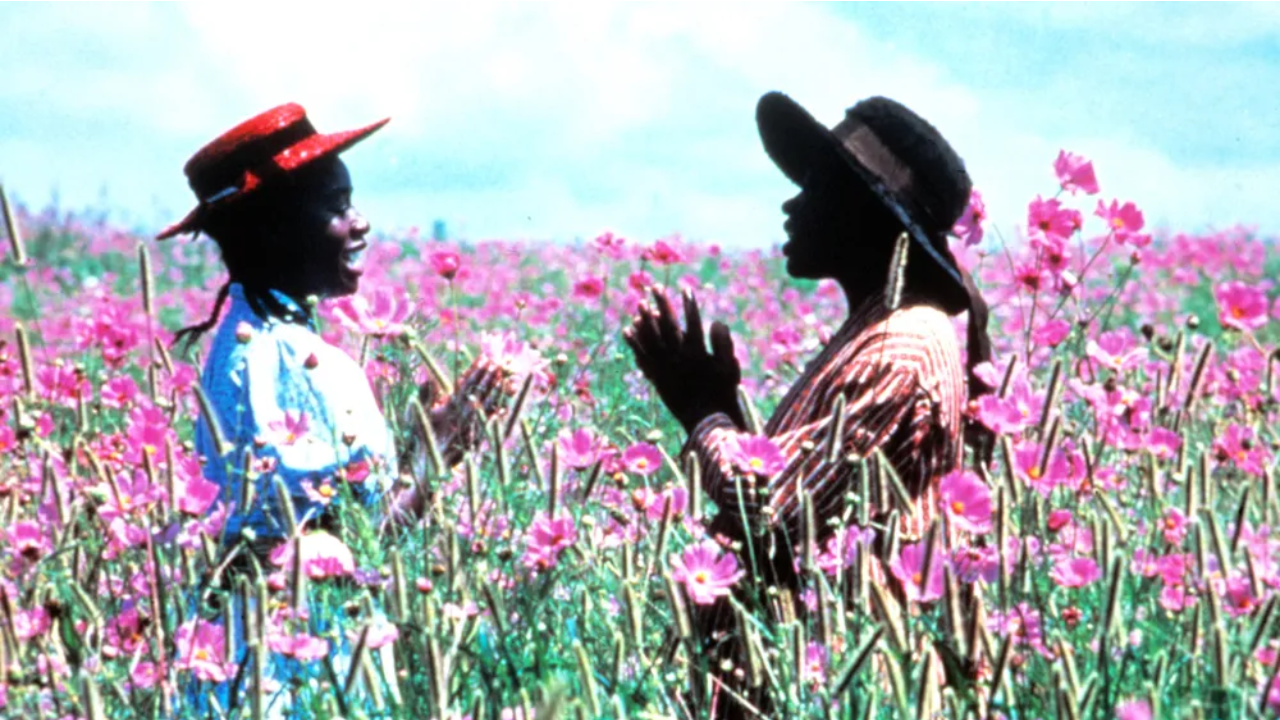
Nettie and Celie are playing in a vibrant field of purple flowers
Image Source: Variety
The eighth film that Spielberg directed, The Color Purple was a departure from summer blockbusters and a foray into historical drama. This film stretched Spielberg’s storytelling techniques, as it was an adaptation of Alice Walker’s bestselling, Pulitzer Prize - winning book of the same name. The Color Purple takes place in the early 1900s in the Deep South, and it tells the story of Celie, a Black woman played by Whoopie Goldberg in her breakout performance, who is abused by the men in her life. She finds confidence and affirmation through her female relationships, and her ex-husband, played by Danny Glover, redeems himself at the end when he brings Celie and her sister Nettie together after many years.
The role of Sophia, Celie’s daughter-in-law, was Oprah Winfrey’s breakout role as well. Spielberg was hesitant to direct The Color Purple because he did not feel he had the right background to make a film about Black life in the South. Alice Walker, the book’s author, was also reluctant to have Spielberg direct until she saw ET: The Extraterrestrial. The Color Purple went on to much critical acclaim, though it did get some criticism for being overly emotional from James Greenberg from Variety, and some Black critics, notably James Baldwin, said that it reinforced negative stereotypes regarding Black men and Black family life.
The Color Purple went on to be nominated for eleven Academy Awards, including Best Picture, which included producers Spielberg, Kennedy, Frank Marshall, and Quincy Jones, but won none, which garnered protest from the NAACP. Spielberg won his first Directors Guild of America Award. Roger Ebert called it the “best” movie of the year, and fellow movie maker Oliver Stone called it an “excellent movie”.
1: Schindler’s List (1993)
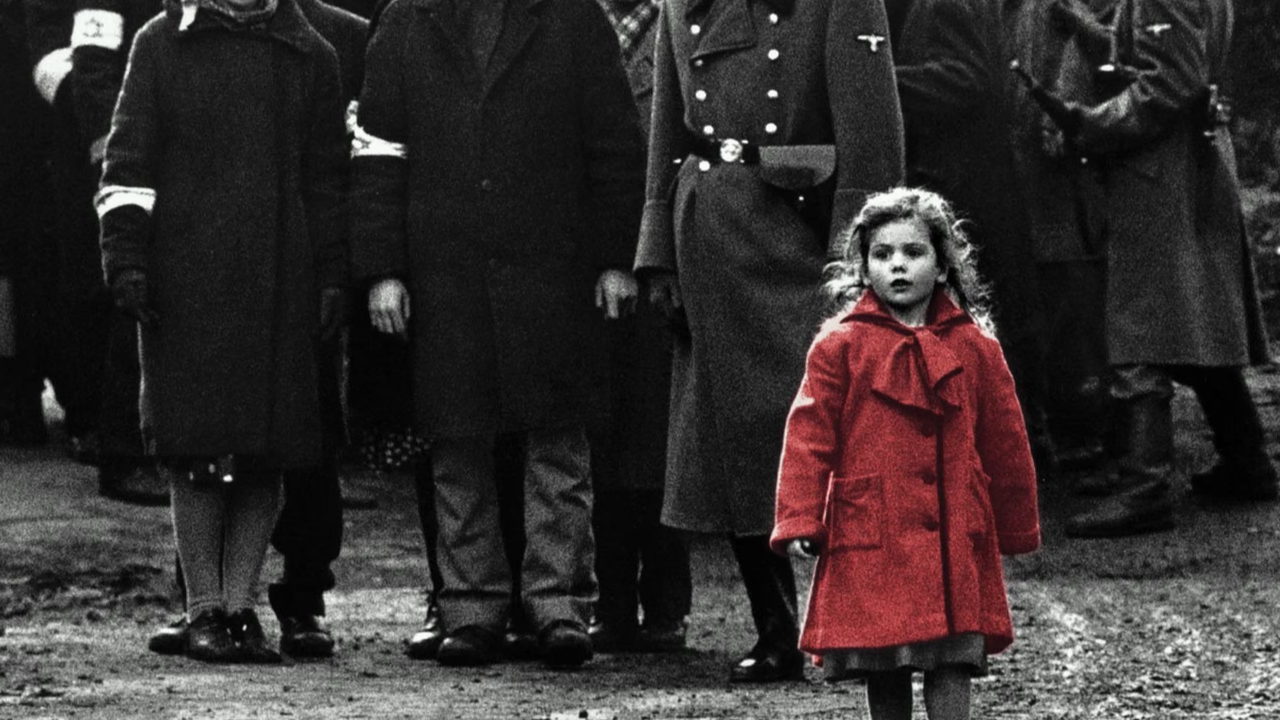
A little girl wearing a red coat stands in front of others who are in black and white
Image Source: The Guardian
While Spielberg had done history before, with the above’s The Color Purple being his first foray into historical drama, he and Amblin Entertainment have left a lasting legacy with Schindler’s List. Adapted from the historical novel Schindler’s Ark by Thomas Keneally, this film shows how Oskar Schindler, a businessman out for his own profit, joined the Nazi party, bought a factory, and benefited from the slave labor of the Jews who were under the Nazi rule. Once Schindler saw what was happening to the people working for him, he became one of the few Righteous Gentiles who did something about it. Through his efforts, Schindler saved approximately 1,200 Jews from being murdered. Spielberg tells this story through black and white filming, putting in color in very few elements, using hand-held cameras for many of the scenes, and keeping the filming at eye-level. The result is that you are witnessing this part of the Holocaust at your level, and there is no way to turn away.
John Williams’s beautiful score with Itzhak Perlman on the violin is moving at every turn. My grandfather who miraculously survived Majdonik, Aushwitz, and a notorious death march, said that Schindler’s List was the most accurate portrayal of what went on in the camps, and that’s endorsement enough for me. The critics thought so too, as Schindler’s List was nominated for twelve Academy Awards and won for Best Picture, Director, Adapted Screenplay, Original Score, Film Editing, Cinematography, and Art Direction, while Liam Neeson and Ralph Fiennes were nominated for their acting. Schindler’s List is on many Top 100 Movie Lists, including Time Magazine’s, Leonard Maltlin’s and Channel 4’s. The Vatican even put it on their 45 most important film list, and Pope Leo XIV just mentioned it in a speech a couple of months ago.
Spielberg, who took no salary for making this film, created the USC’s Shoah Foundation to record Holocaust survivors testimony, which films survivors talking about their pre-war and war experiences. Krakow, Poland has a museum dedicated to its Nazi occupation and the actual Schindler’s factory has become a museum as of May 2025. Most importantly, we find out that because of the 1,200 people that Schindler saved, there are approximately 8,000 of their descendants in the world. As it says on the ring given to Schindler by the people he saved, "Whoever saves one life saves the world entire." (The Talmud)
CultureSlate: Made by humans, for humans.
Please consider supporting our AI-free content via our Patreon page.
READ NEXT:

Latest News

Featured




• All sizes are adult unisex
• Printed art on the front
• 100% cotton
• Pre-shrunk fabric
• Shoulder-to-shoulder taping
• Culture Slate Exclusive Design
See more products here